
This website is dedicated to the yew tree as one of our first and greatest spiritual teachers. I am honored to have been called to learn from one such teacher - a solitary and ancient female yew tree in Scotland that not only renewed my dying body, but gave me deep insight into an ancient practice of healing that I have named Yewshamanism. It is my belief, based on over ten years spent at the yew tree, that my healing experiences represent part of the 'language' of the yew that was known by the yew 'initiates' - those who venerated the yew tree and worked with its power until 17th century. The language of the yew communicates with the body from the subtle and generative realms of the Otherworld, inspiring the arts of seership and prophesy, as well as illuminating the ability to access our innate self-healing processes. It is a language that must be learned from the beginning by each initiate as the creative impulse at the heart of healing and Wholeness. Today it is difficult for us to see the important role that the yew played in shaping the spiritual landscape of our earliest history. Much of the ancient yew stands no longer exist and the yew trees that have survived are impossible to date accurately. The decline of the yew as the World Tree is a long process that involved a psychological shift in the focus of veneration leading away from the mountain mothers - the sacred yew trees in the high places - and into a literal descent toward the masculine deities who came to be associated with the growing villages and towns of the fertile river plains. The profoundly violent physical decline of the yew is mainly a consequence of warfare and its culmination in the Medieval arms trade which decimated the European yew well into 16th century. The yew has been described as 'one of the most negatively affected European trees by human intervention' with the two main threats to the tree today coming from general deforestation and the hunt for taxanes. (Hageneder 2007). The yew is now a protected species in a handful of countries although there is much more work to be done to raise greater awareness of the significance and plight of the yew tree.
The yew tree is like a magic mirror to mankind. Historically, our treatment of it reflects the face of death or of life in the complexion of our beliefs and actions. During our earliest history the yew both reflected and was directly symbolic of the balanced forces of birth, life, death and rebirth. When we listened to its voice we were given the World Tree and the goddess archetypes, as well as sacred laws to live by and a ritual center for the original sacred marriage between the 'King' and the fertile land. In the Medieval period we chose to see our reflection as the face of death, and so the yew became valued entirely as a weapon of destruction in the form of the longbow. We virtually destroyed the World Tree in order to murder and dominate our own kind. For the last 500 years - apart from a few sects who survived into 17th century - we abandoned the yew altogether. In 1960's we stumbled again on the life aspect of the yew, this time as a cure for cancer, and began mercilessly cutting down the old yews for their bark - taking us back to the face of death again! Now there are even yew plantations where the growth of the naturally slow - growing yew is accelerated so that they can be harvested in less time for their taxanes. This may adversely affect the old yew trees, ( see main text). It is more than a mere coincidence that the yew has imprinted our consciousness with its own image at critical times in our history. It has offered itself over and over again as a symbol of the deep and bleeding wound in the spirit of humanity that can yet heal. Over and over again the yew has sacrificed itself in order to teach us this one simple truth. Yet we do not listen, and now there are not enough yews left for another sacrifice. We are very fortunate that the World Tree lives on in the last few surviving ancient yew trees. These wise elders can still teach us this one simple truth:We have the ability to heal. We have the ability to choose to heal. We have the ability to choose to heal ourselves and our world. The language of the yew tree can be learned as a healing force just as it was learned by our ancestors in the mountains thousands of years ago. There always was and always will be a way to learn from the yew, and that is directly through the heart and the guts. The nature of the yew has show us that where there is poison there is also a cure. We have tasted enough poison.
Yewshamanism
Yewshamanism is a metaphor serving to convey the elements of a shamanic practice given experientially by the sacred yew tree. Yewshamanism, as I have named it, is the reinterpretation of an ancient art of healing and transformation. This art is inscribed directly into the consciousness of the entire soma, revealing an archetypal language of Wholeness that is thousands of years old. The yew tree elides all human expressions of its reification as fixed mythology. Its power must be re-discovered anew by each initiate. Therefore there is no direct transmission of a definitive 'sacred text' from the yew tree. Its 'text' is a process and a living language written on the body of each initiate through practice. Yewshamanism provides a structure for the power of the yew to be experienced and absorbed. This structure is based on a series of profound experiences I had under the tree over a ten -year period, where I was led through and beyond death, and finally transformed into a new being. Yewshamanism is a practice that continues to develop with effort and awareness. The meaning in Yewshamanism remains phenomenological, experiential, instinctual and sensual. For over ten years under the yew, I was literally pulled apart and stretched across galaxies and dimensions of being whose edges converged as a smear of meaning, or a final glimpse of sanity that vanished into condensed points of emptiness. Under the vast canopy of the tree, I witnessed the ritual and dance of the ancestors who venerated and cared for it, and learned the practices that they were given by the yew tree spirits to embody its power. I was led to understand that the space within and around the yew tree is a key function of its power - part of an ongoing process of renewal. The remaining ancient yew trees in the British Isles will reveal nothing material from their ancient pasts. This is why it is impossible to determine their age unless a planting date is known. The mystery of the yew tree's immortality was embodied by our ancestors through the culturally specific ritual enactment of core aspects of the yew-tree-goddess archetype involving birth, death, transformation and rebirth myths. As the World Tree, the yew provided a sacred center offering access to the realms of the Underworld and to the skies of the Kosmos. Today, the creation mythologies that were given by the sacred yew tree are returning in new forms.
Since the late 1960's the yew tree that was either simply ignored, destroyed or threatened has been rediscovered and revalued as a cure for cancer. Wisdom that was known and cherished for thousands of years, that was given from a sacred and immortal being, seems to be finally returning to us. But the dominant form of the return of that wisdom is a partial realization, a compromise and denigration of meaning, bound to the biotech-pharmaceutical industry as a commodity, and very much at the expense of the continuing existence of many yew trees - India has lost 90% of its yews since 1992 because of the demand for taxanes, and the increase in yew plantations worldwide may create genetic pollution threatening the genetic diversity of the surviving native yew trees ( Hageneder 2007) This is in no way meant to downplay the importance of Taxol/Paclitaxel to the many cancer survivors, many of whom have in fact been led to a deeper understanding and appreciation of the tree that has saved them. However, the deeper message and meaning of the sacred yew tree must be heard and appreciated in a wider context. It is no accident that many authorities now fully believe that the Yew tree is indeed the World Tree/Yggdrasil. The message of the yew, as given from the yew itself, inspires a return to our sacred origins and to the reinterpretation of a knowledge that was once widespread. The yew reunites us with a sensory language of rejuvenation and health - a language of transpersonal archetypes able to activate the power of our individual biomythology as a ritual healing force. This is the essence of the Yewshamanism that was known by other names throughout the ancient world, in Greece, in India, around the area of the Black Sea, and of course throughout the British Isles. The ancient native yew trees of the world must be protected both as sentient beings and as the custodians and gatekeepers to the ever-present forces and mystery of our sacred origins. Look at many of the place names throughout the British Isles in particular, and you will see that the name of the Yew is that place! The evidence for the widespread veneration of the yew tree is right in front of our faces. It's time for us to see it.
The Hermeneutics of Yewshamanism
Individual phenomena must never be torn out of context. Stay with the phenomena, think within them, accede with your intentionality to their patterns, which will gradually open your thinking to an intuition of their structure.
- Goethe
As an expression of the world tree, the yew is imprinted with both the cosmogonic and the cthonic archetypes. As a sentient being, the yew is its own language and its own explanation, revealing itself in terms of itself, complete in its own dimension of wholeness. Approaching the hermeneutics of the yew presents a series of perceptual paradoxes, revealing an originality of being that is at the same time homologized to eternity. Embodying the language of the yew requires a restructuring of consciousness that involves and initiates the conditioning and transformation of the perceiving soma.
The Gestures of the Yew
...to let that which shows itself be seen from itself in the very way in which it shows itself from itself - Heidegger
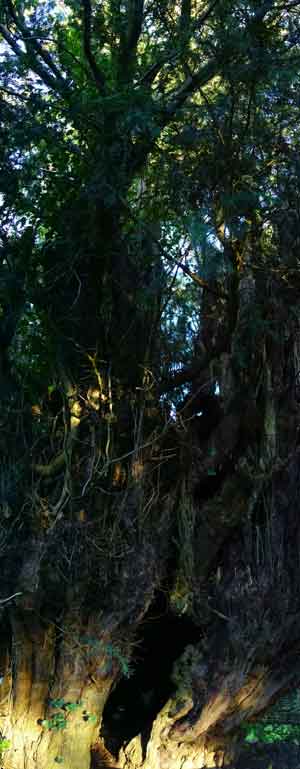
Look at the photographs of the yew tree in the pages of this website. What do you 'see' happening? What is the yew tree 'doing'? What are the 'gestures' of the yew tree? Our ancestors embraced the meaning of the yew tree on at least 3 levels of instinctual awareness. Firstly they were able to read the gestures of the yew as it showed itself from itself. This is not the same as simply looking. They were able to stay with the phenomena and therefore to 'see' that the yew embodies space creatively and purposively. In accordance with these perceptions, they developed mimetic rituals that sought to embody the creative principle as it related to birth and origins in a mythic, Kosmic and individually restorative way. In one such ritual several people were bound at the belly area into a long cord, one end of which was fastened around the yew tree. The participants of the ritual began outside the narrow threshold entrance of the yew, and by making sounds and initiating movements they made their passage through the long tunnel into the yew chamber, slowly winding their bodies clockwise around the tree to reach the center. The entire sequence was then reversed. Unfortunately the surviving yew trees in UK no longer gesture in the way that they did some hundreds to thousands of years ago, so it is harder for us to stay with the phenomena. Why is this? The simple reason is that they were cut back and cut back, especially around churches and in graveyards, until their behavior changed and they no longer made the same gestures. This is why the photographs you see on this website are so important. You are seeing the yew tree in a complete and original state of being in itself. The surviving yews are beautiful and sacred and they should be cared for, treasured and protected. But, with the exception of basic care and maintenance, we need to leave them alone in the hope that in a thousand years they will return to themselves. So to go back to the photographs and to the question: What does the yew tree do? The yew folds itself around space, it contains. It partially seals the inner space off from the outside environment. Within its chamber the life force of the yew gestures outward through its vast network of branches before it bows and flows with gravity, back to the earth. Its branches reach for its roots. It forms a mandala, creating a polarity of center and circumference. Sometimes even the very heart of the yew becomes empty space, the trunk becoming hollow for a thousand years or more in anticipation of an ariel root. This root grows downward within the hollow tree at an imperceptible pace, eventually embracing the earth as the anlage and expression of a new center. The yew gestures into, and embodies space. It creates and folds space. Our ancestors saw that the yew tree did not die, but rather that it died continuously to itself, folding itself back on its origin as a gesture initiating its rejuvenation. This is a vital function of the yew tree that our ancestors sought to embody within their sacred -somatic existence as expressed in ritual. The yew showed itself from itself and simultaneously as cosmogonic archetype, replicating the unfolding of the human bio-mythology as a tale of origin and the transcendence of death.
The Archetypes of the Yew
One cannot manufacture a symbol, one can only discover it. - Edinger
The second level of instinctual awareness involved the perception and internalization of the fundamental elemental forces, the archetypes of the yew tree. If the yew tree cannot be seen by us showing itself from itself, the archetypes will not be perceived. This is very important to understand. It was made very clear to me that those who venerated the yew tree did so from within an experience of the phenomena that they perceived. They saw the creation of the universe and themselves in the gestures of the yew itself. The archetypes and symbols they worked with were revealed through perception of the phenomena. They did not stand under the yew and immediately attempt to create or perceive another reality lying behind or beyond it. It is a big mistake to do this and sadly, I have seen this resulting, more often than not, in a fantasy that speaks more of dissociative states, and a confused autonomic system overloaded by stress, than any meaningful transformation. The deeper dimensions within the yew reveal themselves to the initiate in time, with practice and only through the archetypes and the transformation and healing of the soma. Over ten years at the yew tree I was given several archetypes to work with as transformational and healing forces. In a teaching situation I begin by describing 3 main archetypes that, as elemental and formative forces, correspond to key physiological -energetic centers. This is a practice in altering consciousness. It is important to note here that these archetypes and practices are used individually. These practices are emphatically NOT guided meditations. I do not work with guided meditations because I believe that each initiate has their own unique bio-myth waiting to be claimed and worked with as a pattern of original wholeness. We are creative beings, we do not need to be led. However, the yew archetypes are real in that they are elemental fores that were revealed to others before us. It is how we approach them and what we do with them that counts.
Biomythology and the Yew
...Symbolic death signifies a regression to the embryonic state. But this is not to be understood only in terms of human physiology but also on cosmological terms; the fetal state is equivalent to a temporary regression to the virtual, precosmic mode.
-Eliade
The third level of instinctual awareness relates to what Eliade has called the 'Myth of the Eternal Return' where healing was synonymous with a return to origins. Our ancestors perceived illness and disease as the outward expression of a dis-harmony with the spirit world and with the environment. In order to cure the sick person it was necessary for them to be symbolically reunited with the moment of their origin, and more importantly that this moment be contemporaneously symbolic with the birth of the universe itself. In this way they were restored by being reborn into a harmonious relationship with nature and spirit at the mythic moment where all things came to be. The yew spoke to my entire soma in a very direct, and for me, extremely painful way, and in so doing entirely transformed a body close to death into a renewed and vital being. I describe my shamanic initiation in more detail in the book “ Soul Companions”. I was shown that the mystics and 'shamans' who communed with the yew in the distant past were given the same somatic language by the tree, a sacralization of the body and its organs that was used and understood as a method of healing and rejuvenation. This was an extremely sophisticated language of the body that involved long periods of incubation and deep stillness as well as strict meditations and movements - a kind of dance with the elemental forces under the tree. Each organ and sacred center of the body is activated by an archetype revealed by the yew which when perceived by the body in a trance state, reveals a language that can be used in many ways, especially for healing purposes. I go into this in stages and in detail in my teaching. My teaching is not about shamanic initiations, since only spirit decides who becomes a 'shaman'- but the language of the resacralization of the soma is nonetheless very powerful and empowering. It can also be uncomfortable and challenging, and many people report having to work very hard at this. It takes courage and dedication to reclaim the sacredness of life - the process of who we are being, and who we are becoming. The purpose of our incarnation is to make manifest the creative movement of our Wholeness as an individuality that is not determined by genes, ideologies or limiting beliefs.
The yew tree asks that you respect its physical space, that above all you trust in your ability to use your heart to reach out to it for guidance, no matter where you live on this planet. The yew inhabits private land so if you are called to visit the tree in person you must obtain permission from the current owners of the land. The name of the yew is revealed in the book " Soul Companions - Conversations With Contemporary Wisdom keepers - Encounters With Spirit "
Check the events page for forthcoming workshops on Yewshamanism.
This section contains excerpts from my contribution to the recently published book Soul Companions by Karen Sawyer.
Excerpt One - Introduction and first chapter
TEN YEARS UNDER THE YEW TREE by Michael Dunning Michael first became aware of his latent shamanic abilities in the far north of Scotland during an encounter with a powerful earth spirit that almost took his life. His state of health slowly deteriorated. Several years later, he was struck down by a bolt of light from the sky and became seriously ill. This marked the beginning of his ten-year shamanic initiation that took place under the vast enclosure of a sacred 2000-year-old yew tree in his homeland of Scotland. Michael believes that the spirits at the yew tree were passing on a sensory and experiential knowledge that once belonged to the indigenous shamans of Scotland. He leads shamanic workshops throughout New England and teaches and runs a practice as a Biodynamic Craniosacral Therapist. Michael is also a musician and a visual artist. In 1999, he was invited to compose and perform as part of a concert in Edinburgh celebrating the reconstruction of the Deskford Carnyx - the Celtic war horn depicted on the Gundestrup Cauldron. His composition, ‘Taxus Baccata’ is a musical interpretation of a possible meeting between the yew tree and the carnyx. Michael has also been awarded two musical study grants from the Scottish Arts Council. Michael currently lives in Western Massachusetts with his wife Chelynn and Wallace the cat.
The Tree Surgeon I stood fragile and still inside a darkened and tangled cocoon vault, gazing into the contracting afternoon liquid light that slid through gaps in an intricate weave of branches, casting mottled washes of gold, Turner watercolor fragments against the south western profile of the yew tree. To this day, I wonder that this perfectly inverted cauldron of branch contortion could admit any illumination at all. Moody dark for most of the day, and certainly during nights without a full moon, the great yew goddess would sip in the last light of each day as her delicacy… a taste of potency to be gathered and bound only during those dying moments. But the true light source of the yew came from elsewhere. The previous night, I had climbed to the top of this sacred goddess, guided by the light of the moon and a local tree surgeon named Bob who had dragged me from the village pub after I admitted both ignorance of yews as a species of tree and that I had never visited the ‘cathedral’ in my own Scottish back yard. At that time my illness was advanced, so walking any short distance could exhaust me for days. But there I was, blind drunk, in the middle of the night, stumbling over broken branches and jagged bushes to visit a tree I had neither heard of, nor, if truth be told, was interested in. The effects of the alcohol, the tree surgeon’s animation and something else, a curious feeling previously unknown yet irritatingly familiar, had compelled me. After about ten minutes Bob stopped. “Here we are… you first!” “What?” “This is it,” he whispered… I couldn’t see any tree at all – only a small, dark and circular opening in what looked like a huge bush. I laughed pathetically. “You’re kidding, right?” “In you go!” He waved his hands dramatically, feigning impatience. I had to bend almost double to get into that black hole. It was cold. I shuffled forward without lifting my feet off the ground. I realized that this was a narrow tunnel because each time I tried to raise my head a few inches, it touched a ceiling of sharp, pointed branches. I encountered the same spiked barrier on either side as I reached out with my arms. The ground of the tunnel rose gently and evenly for the first 20 feet, then began to incline more steeply. I shuffled another 25 feet and began to make out what looked like a doorway of sorts. I reached forward with my left hand and touched a cold iron rail, feeling tiny flakes of rust sticking to my palm. I found the partner rail on the other side and using both hands hauled myself through an entrance. The ground seemed flat and I raised my head tentatively – no ceiling this time. I stood up slowly, waving my arms around in front of me and took a tiny step forward. Repeating this bizarre sequence, I advanced two or three steps further and then stopped. My eyes had adjusted to the darkness and by the light of the moon I could make out my position at the edge of a large, and enclosed circle perhaps 50 feet across. In the middle of the circle was a huge black mass that I took to be the trunk of the tree. Moving closer and looking up I followed the trunk to the buds of its massive branches, but instead of continuing horizontally into space they swooped back down to the earth in long graceful arcs forming an inverted basket shape. As my eyes traveled the underside of one of the branches on its descending trajectory, I almost fell over backwards. Righting myself, I walked some 15 feet from the trunk to where one of the huge limbs reached the ground and, squatting, ran my hand around the area where it met the soft earth. The bark came away in flakes. I rested my hand there for a few seconds and my head began to feel heavy. I felt sleepy. At first it seemed that the branch had actually entered the earth. On closer inspection, I realized that it turned at a right angle just under the surface of the earth, and continued half buried along the ground. I rose and walked another 10 feet or so alongside the slithering shape toward what appeared to be one of a multitude of smaller trees that made up the internal circumference of this vast enclosure. I couldn’t see a way in or out other than the tunnel I had just navigated. The ground seemed a writhing mass of snakes tripping and snagging at my feet. ‘How could a tree do this?’ I wondered. I didn’t even hear Bob coming up behind me. “Bloody amazing, eh? What de ye think?” “I don’t understand it,” I whispered sharply, “Is this all the same tree? I mean it can’t be... right? It’s all different trees mixed up!” “Nope, just the one tree,” he declared proudly, “All 400ft in circumference of it, biggest in the country and it’s a she.” “A ‘she’? Come off it!” I rebuked. “Oh yes, she’s a she a’right. Yews are dioecious which means they are either male or female. Not only that, but you are in the presence of the oldest female you are ever likely to meet so you’d better mind yer manners!” “How old is it… err, she?” I asked. “Could be over 1000 years old!” was his reply. (This turned out to be a modest guess – the yew is considerably older). I was stunned. “Anyway, welcome,” Bob said, “to an unknown wonder of the world.” The next afternoon, sober and alone, I returned. At the threshold entrance of the yew tree I smiled briefly for the first time in many months. I felt that I had finally come home. Flexing my body almost in half, I crossed the threshold and entered into the twisting, cathedral plexus – the great enclosure of the sacred yew tree. Upon entering the main chamber for the first time in the partial light I began to weep, and wept uncontrollably for over an hour. Then I slept, curled up against the tree roots. The convulsions woke me up violently, my body whipping up into the thick, musty air above the serpentine roots, my back arching well beyond its physiological limits as if pushed from below. The space within the enclosed area had become dense like water and was pushing painfully against my body, arching me upward and then slamming me back onto the ground. My head and chest felt compressed, making breathing extremely difficult, and my left eye was burning as if an acidic solvent was being applied directly to my retina. I can’t say how long this lasted… I lost all sense of time, but just as it was passing, I saw flickering lights and sensed many presences around me. I had no idea then that this was the beginning of a ten-year journey of pain, transformation, learning and, ultimately, healing. This is the story of my shamanic initiation in Scotland under the
yew tree.
The photographs used in this website are copyrighted. Anyone wishing to make use of the images in this website must obtain the prior consent of the photographer or of Michael Dunning. Thankyou.